Ingredients
Method
- Set the chicken breast-side down. Cut along both sides of the backbone with kitchen shears and pull it out (save it for stock). Flip the bird over and press down hard on the breastbone until it cracks and the chicken lies flat. Tuck the wing tips behind the breast and pat it very dry with paper towels.
- Mix the rub, adding the baking powder if you're using it. Rub the oil over the chicken, then season it all over, top and bottom. For the best skin, set it on a rack over a sheet pan and refrigerate it uncovered for 4 hours or overnight. Otherwise let it sit about 30 minutes while the fire gets going.
- Fill a chimney with charcoal and light it. When the coals are ashed over (12 to 15 minutes), dump them into the charcoal basket in the side firebox. Open the firebox damper about halfway and open the smokestack damper all the way, then close the lids and let the smoking chamber heat up.
- Chicken does better hotter than beef; below about 275°F the skin turns rubbery. Add 2 of the wood chunks to the coals, then use the firebox damper to steer the heat: open it more to go hotter, close it down a little to cool off. Leave the smokestack open so the smoke keeps moving. Wait until the heavy white smoke settles into a thin, light smoke before the chicken goes on.
- Lay the chicken skin-side up on the grate in the smoking chamber with the legs pointed toward the firebox. That end runs hotter, so the dark meat gets the extra heat and the breast stays juicy. Put a probe thermometer in the thickest part of the breast and close the lid. Smoke 60 to 90 minutes, adding a few coals or the last wood chunk if the temperature starts to drop, and turn the chicken around halfway if one side is browning faster.
- When the breast reads about 150°F, light the gas grill with the two outside burners on medium-high and the middle burner off. Close the lid and let it heat for about 10 minutes, to roughly 400–450°F.
- Move the chicken to the gas side, skin-side up over the unlit middle burner. Brush it with the melted butter and close the lid. Cook 10 to 15 minutes, until the skin is crisp and a thermometer reads 165°F in the thickest part of the breast and at least 175°F in the thighs. Keep it off the direct flames, since chicken fat flares up fast.
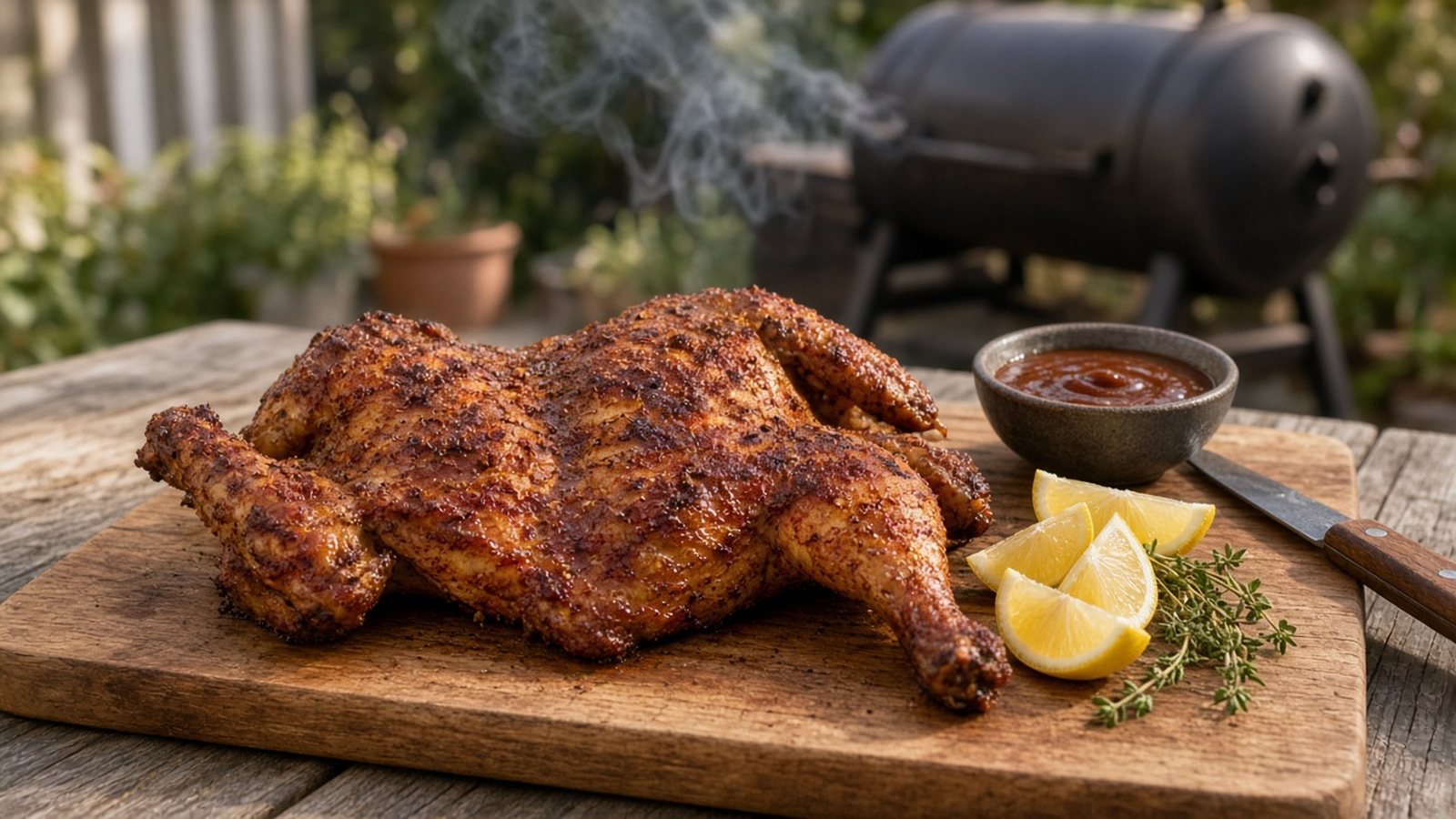
- Let the chicken rest uncovered on a cutting board for 10 minutes (covering it softens the skin). Cut it in half down the breastbone, then into legs, thighs, wings and breasts. Serve with lemon wedges and BBQ sauce on the side if you like.
Notes
Doneness and food safety: The USDA safe minimum for chicken is 165°F. Check the thickest part of the breast and the thigh, without touching bone. Thighs are at their best around 175–185°F, and pointing the legs at the firebox helps them get there while the breast stays at 165°F. Clear juices aren't a reliable test, so use a thermometer.
About the lid gauge: The thermometer in the lid reads the air near the top of the chamber, which can be different from the grate where the chicken sits. If you have a probe that clips to the grate, trust that one.
No water pan needed: For a short, hot cook like this one, extra steam just softens the skin. Save the water pan for long cooks like pork shoulder.
All-smoker option: Skip the gas side and leave the chicken in the smoking chamber until it reaches 165°F in the breast. The skin won't be as crisp, but the flavor is all there.
Wood: Chicken takes on smoke quickly, so 2 or 3 chunks is plenty. Cherry gives the skin a deep reddish-brown color, apple is milder, and hickory is stronger.
Leftovers keep 3 to 4 days in the fridge and are great in sandwiches, quesadillas or chicken salad.